The Villa Bill
When paying your fair share becomes paying someone else’s too.
Valencia del Sol is a beautiful community filled with good people. That’s exactly why this issue matters.
Twin Villa homeowners are not asking for special treatment. We are asking for fairness, transparency, and consistency with the financial structure homeowners purchased into.
This Wasn’t Just Another HOA Increase
Most homeowners understand assessments rise over time. Twin Villa homeowners have seen yearly increases too.
But the 2026 budget did something fundamentally different.
This was not simply inflation, rising maintenance costs, or a community-wide increase shared equally.
The issue isn’t that assessments went up.
The issue is WHO they went up for.
The result?
Twin Villa homeowners now pay more and Single Family homeowners pay slightly less.
And no one really benefited. That’s the heart of the issue.

This wasn’t shared sacrifice.
It was shifted sacrifice.

The Core Fairness Question
Imagine going to dinner with friends. You order modestly, and they order extras — appetizers, drinks, dessert.
When the bill comes, someone says, “Let’s just split it evenly. It’s easier that way.”
That’s what the Villas are experiencing.
Most people would immediately understand why that feels unfair.
Why Many Villa Owners Believe This Is Unfair
Twin Villas are not the same as the larger detached homes throughout Valencia del Sol.
- Villa lots are generally smaller.
- Twin Villas share a wall, which means landscaping exists on three sides instead of four.
- Villa owners cannot install pools.
- Villa owners cannot fence their yards.
In simple terms:
Smaller lots and shared walls generally mean less landscaping area per home.
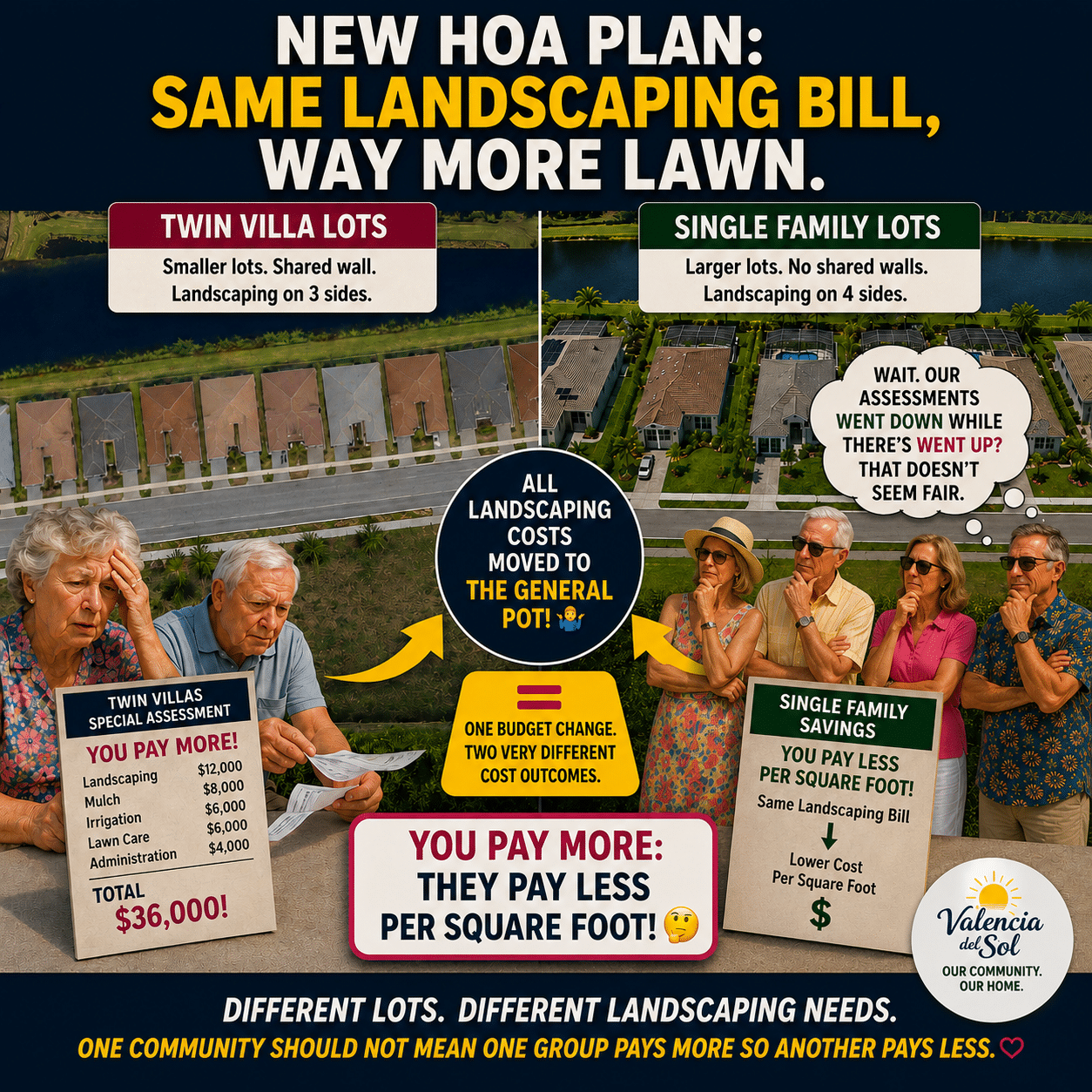
For years, the budget reflected those differences by separating Twin Villa landscaping costs from Single Family landscaping costs.
Then that changed.
Under the 2026 budget, all landscaping costs were moved into the general landscaping category.
The result is that Twin Villa owners with smaller lots and smaller landscaping burdens are now paying more. Nothing else changed. Landscaping didn’t improve. Accounting didn’t become less expensive.
That’s why many homeowners believe this issue is fundamentally unfair.
What The Board Appears To Be Arguing
The Board has confirmed its position: because certain landscaping-related expenses were not specifically listed in the governing documents the same way as some other Twin Villa expenses, the Board has broad authority to reclassify those costs through the budgeting process.
We understand that argument and disagree.
This issue goes far beyond ordinary budgeting discretion.
For years, the structure was clear in practice.
The budgets, assessment structure, and the community’s historical practice treated these costs as expenses associated with the Twin Villas.
Homeowners purchased homes relying on that structure.
Then, through the annual budget process, the financial burden shifted.

A Simple Principle
If the Board truly believes this is the correct long-term way to allocate these costs, then it should openly make that case to homeowners, explain why the burden shift is justified, and properly amend the governing documents.
If this is the right long-term structure, why not let homeowners vote on it?
That’s the issue. Not secrecy. Not hostility. Not division. Fairness.
Why This Matters Beyond The Twin Villas
Today, this affects Twin Villa homeowners.
Tomorrow, it could affect another section of the community.
This issue is bigger than landscaping. It’s about whether homeowners can rely on the governing documents, the financial structure, and years of historical budgeting practices.
The Board didn’t just raise assessments. It redistributed them.

Review The Documents Yourself
We encourage every homeowner to review the materials directly. Transparency matters.
Governing Document Excerpts
Relevant provisions regarding assessments, Twin Villa assessments, and Board authority.
Legal Opinion Letter
Once available, this section will contain legal opinion letter(s).
Coming Soon →
Frequently Asked Questions
A plain-English explanation of the issue, the Board’s likely argument, and the homeowners’ fairness concern.
This Is Not About Fighting Neighbors
Single Family homeowners are not the enemy. Most homeowners likely had no idea how the budget restructuring affected the Twin Villas.
This issue is about governance and fairness.



A Little Humor. A Serious Issue.
Sometimes a meme explains a complicated issue faster than a spreadsheet.
That’s why this site uses humor and satire.
But behind the jokes is a serious question:
Is it okay for the Board to raise assessments on one homeowner group while lowering them on another with no benefit to the community?
Many Twin Villa homeowners believe the answer is no.
What You Can Do
Final Thought
Valencia del Sol is strongest when homeowners believe the rules mean what they say, major financial changes happen transparently, and fairness applies equally to everyone.
One community should not mean one group pays someone else’s share.

Frequently Asked Questions
What is this issue really about?
At its core, this issue is about fairness and whether one group of homeowners should be asked to pay more so another group can pay less.
Twin Villa homeowners believe the 2026 budget changed the way certain landscaping-related expenses were allocated, shifting additional financial burden onto the Villas while reducing costs for Single Family homeowners.
Many Villa owners believe this was more than a normal budget increase. They believe it was a structural change in who pays for what — one that should have required a formal amendment to the governing documents.
Are Twin Villa homeowners upset simply because assessments increased?
No.
Most homeowners understand that costs rise over time and that assessments may increase.
Twin Villa homeowners have experienced annual increases before.
The concern here is different.
The concern is that the Board changed the allocation of certain expenses in a way that increased Villa costs while reducing costs for another homeowner group.
That’s why many homeowners view this as a fairness issue rather than a routine increase.
What expenses are at issue?
The dispute primarily involves landscaping-related expenses, including items such as:
- landscape maintenance,
- mulching,
- irrigation.
Historically, landscaping-related expenses for the Twin Villas and Single Family homes were budgeted separately.
The 2026 budget changed how those costs were allocated.
Why do Twin Villa homeowners believe the governing documents were violated?
Many Twin Villa homeowners believe the Board effectively changed the long-standing assessment structure without properly amending the governing documents.
The argument is not simply:
“The Board cannot approve budgets.”
Of course the Board can approve budgets.
The concern is that the Board used the budgeting process to materially shift financial burden from one homeowner class to another.
Villa homeowners believe:
- the governing documents created separate assessment structures,
- landscaping services provided directly to a specific homeowner group are expenses that specifically benefit that group,
- historical budgets consistently reflected that structure,
- and homeowners purchased relying on that structure.
Many homeowners believe a major reallocation like this should require a formal amendment process rather than a budget reclassification.
What is the Board’s position?
The Board’s apparent position is that certain landscaping-related items were not specifically listed in the governing documents the same way as some other Twin Villa expenses.
Because of that, the Board appears to believe it retained discretion to classify those costs differently through the budgeting process.
This is a legal and interpretive disagreement.
Twin Villa homeowners disagree with the Board’s interpretation.
Is this simply a disagreement over legal interpretation?
Partly, yes.
This issue involves:
- governing document interpretation,
- assessment authority,
- historical budgeting practices,
- and whether the Board had authority to materially shift financial burden between homeowner groups through the budgeting process alone.
This is not simply an emotional disagreement over higher dues.
Florida law provides a mandatory pre-lawsuit mediation process for certain HOA disputes, and homeowners hope the issue can still be resolved constructively and transparently without having to pursue further legal remedies.
Why does historical practice matter?
Because for years the budgets and financial structure treated these expenses in a particular way.
That structure continued even after turnover from GL Homes and remained in place through the 2025 budget before changing in 2026.
Homeowners make purchasing decisions based partly on:
- expected assessments,
- the community’s historical practices,
- and how costs have traditionally been allocated.
Many Villa owners believe homeowners should be able to rely on long-standing financial structures unless homeowners properly approve a change.
Are Twin Villa homeowners asking for special treatment?
No.
Twin Villa homeowners are not asking to avoid paying legitimate expenses.
The concern is whether Villa homeowners are now being asked to pay a disproportionate share of costs so another homeowner group can pay less.
Many homeowners believe fairness means homeowner groups should not unexpectedly absorb costs historically allocated elsewhere unless homeowners collectively approve that change.
Are Twin Villa homeowners arguing they should not pay more than Single Family homeowners?
No.
Twin Villa homeowners have historically paid higher assessments because the Villas receive additional services such as:
- exterior painting,
- pressure washing,
- pest control,
- landscaping of Villa lots,
- mulching of Villa lots,
- irrigation and irrigation repair of Villa lots,
- and other Villa-specific benefits.
Most Villa homeowners understand and accept that structure.
The concern is not that Villa owners pay more.
The concern is that the 2026 budget shifted additional landscaping-related costs into the general budget structure in a way many Villa homeowners believe further increased the Villas’ financial burden while reducing costs for many Single Family homeowners.
Many homeowners believe that is a fundamentally different issue from paying for legitimate Villa-specific services.
Are Single Family homeowners the “enemy” in this issue?
Absolutely not.
Most Single Family homeowners likely had no involvement in the decision and may not have fully understood how the budget restructuring affected the Villas.
This issue is about Board governance, budgeting decisions, and fairness — not neighbor-versus-neighbor conflict.
Why are homeowners using humor and memes?
Because sometimes a complicated issue becomes easier to understand through simple examples.
The memes are intended to:
- explain the issue visually,
- keep the conversation approachable,
- and encourage engagement.
The humor is directed at the situation and the budgeting logic — not at individual neighbors.
What is the amendment process?
The governing documents contain procedures for formally amending portions of the Declaration.
Generally speaking, amendments typically require:
- homeowner notice,
- a formal vote,
- and approval thresholds established in the governing documents.
Many Twin Villa homeowners believe that if the Board truly wants to permanently change the financial structure between homeowner classes, that change should occur through the amendment process rather than through annual budget restructuring alone.
What are homeowners asking the Board to do?
Twin Villa homeowners are asking the Board to:
- restore the prior assessment structure,
and - if the Board still believes the change is appropriate, openly present the case to homeowners and pursue a proper amendment process.
The issue is not just the outcome.
It’s also the process used to achieve it.
Could the Board legally amend the governing documents?
Potentially, yes — if the required amendment procedures are properly followed, including the required homeowner vote.
Twin Villa homeowners are not arguing that governing documents can never change.
The concern is whether the Board effectively accomplished a major financial restructuring without going through the formal amendment process required by the governing documents.
Is this issue only about money?
No.
For many homeowners, this issue is also about:
- transparency,
- predictability,
- trust in the governing documents,
- and confidence that one homeowner group will not unexpectedly absorb costs previously allocated separately.
Why does this matter beyond the Twin Villas?
Because the broader principle affects everyone.
If costs can be shifted from one homeowner class to another through budget interpretation alone, many homeowners believe similar reallocations could occur elsewhere in the future.
That is why many residents see this as a community governance issue, not just a Villa issue.
What remedies does the Board have available?
The Board has several possible options, including:
- voluntarily restoring the prior allocation structure,
- negotiating a compromise,
- seeking additional homeowner input,
- pursuing a formal amendment process,
- or maintaining its current interpretation.
Homeowners are encouraging dialogue and transparency before the issue escalates further.
What remedies do homeowners have available?
Depending on the circumstances and legal advice received, homeowners may:
- continue communicating with the Board,
- seek mediation as provided under Florida law,
- encourage additional homeowner involvement and transparency,
- participate in upcoming Board elections,
- petition for a membership meeting as permitted under the governing documents and Florida law,
- or pursue other remedies available under Florida HOA law.
At this time, many homeowners are focused on education, transparency, homeowner engagement, and obtaining legal clarity before determining next steps.
Is litigation inevitable?
No.
Many HOA disputes are resolved without litigation.
Homeowners hope the issue can be addressed constructively and reasonably through discussion, transparency, and possibly mediation if necessary.
Why are homeowners seeking an independent legal opinion?
Because this issue involves complex legal and governing document questions.
Many homeowners believe it is important to hear from an independent Florida HOA attorney experienced in:
- Chapter 720,
- assessment disputes,
- and governing document interpretation.
That allows homeowners to evaluate the issue based on professional legal guidance rather than rumor or emotion.
Will homeowner contributions toward legal fees be mandatory?
No.
Any contributions toward obtaining a legal opinion are entirely voluntary.
No homeowner is under any obligation to contribute.
Could this issue become expensive for homeowners or the HOA?
Potentially, yes.
Florida law requires certain HOA disputes to go through a pre-lawsuit mediation process before litigation can proceed.
Mediation itself involves costs, including attorney time and mediation fees.
If disputes later escalate into litigation, legal expenses could increase significantly for both homeowners and the Association.
That is one reason many homeowners hope the issue can be resolved transparently and constructively before further escalation becomes necessary.
Would litigation costs ultimately affect the community?
Potentially, yes.
Because HOA legal expenses are generally paid through Association funds, prolonged disputes and litigation can ultimately impact the broader community financially.
Many homeowners believe that is another reason why transparency, open communication, and early resolution are important.
What is the ultimate goal?
The goal is simple:
A fair, transparent resolution that respects:
- the governing documents,
- homeowner expectations,
- and the principle that major financial burden shifts between homeowner groups should occur transparently and with proper homeowner approval.
Final Thought
Valencia del Sol is strongest when homeowners trust:
- the rules,
- the process,
- and the fairness of the community’s financial structure.
That trust matters for everyone — not just the Twin Villas.